


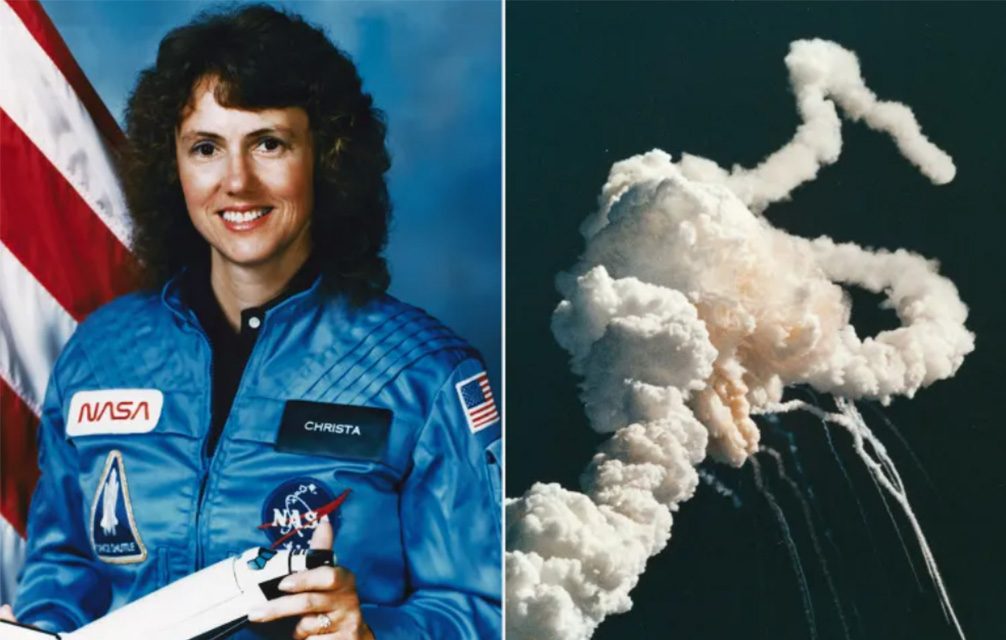
On January 28, 1986, millions of Americans watched in horror as the Space Shuttle Challenger disaster was broadcast live on television just moments after liftoff. What was meant to be an inspiring moment in American space exploration quickly became one of the nation’s most devastating tragedies.
The disaster killed all seven crew members on board, including Christa McAuliffe, a schoolteacher chosen to become the first civilian in space. While historical facts such as the cause of the explosion, the failed O-ring seals, and the investigation that followed are important to understanding the event, personal accounts provide a deeper understanding of how the tragedy affected ordinary Americans.
In an interview, Elaine Cooke-Cudd described the shock, confusion, and grief she felt while watching the disaster live with her young children, revealing how personal and emotional the event became for families across the country. Personal accounts enrich one’s understanding of momentous historical events because they reveal the emotional impact of history, help modern audiences connect to the people who experienced it, and show how national tragedies affect everyday lives beyond the historical facts alone.
The Space Shuttle Challenger disaster should be considered a momentous event because it shocked millions of Americans and changed the way the public viewed space exploration. On January 28, 1986, the Challenger space shuttle exploded only seventy-three seconds after liftoff from Cape Canaveral, Florida, killing all seven crew members aboard (Benson). Unlike many tragedies in history, this disaster unfolded live on national television while millions of Americans, including schoolchildren, watched in real time.
The mission had attracted enormous public attention because Christa McAuliffe, a high-school teacher from New Hampshire, had been selected as the first civilian and teacher to travel into space. In the Dictionary of American History, historian Bruce J. Evensen explains that “Perhaps no tragedy since the assassination of President John F. Kennedy in 1963 had so riveted the American public as did the explosion of the space shuttle Challenger on 28 January 1986.
This comparison demonstrates the emotional and cultural impact of the disaster on the United States. The tragedy interrupted what was supposed to be a hopeful and inspiring moment in American history and instead became a national moment of grief. Because so many people witnessed the explosion live, the event felt deeply personal to families across the country and remains one of the most remembered tragedies in the history of NASA.
The long-term consequences of the Challenger disaster also contribute to its momentousness because the tragedy exposed serious flaws within NASA and led to major reforms in the American space program. After the explosion, investigations revealed that faulty O-ring seals on the shuttle’s booster rockets failed in the freezing temperatures on the morning of the launch. According to the Space Exploration Reference Library, investigators concluded that “NASA and Thiokol [an aerospace contractor that manufactured the Space Shuttle’s solid rocket boosters] had sufficient time to correct the O-ring problem, but the space agency and the manufacturer had sacrificed safety to meet flight schedules and cut costs” (“Challenger Crew”).
This finding transformed the disaster from a tragic accident into a preventable failure caused by poor decision-making and pressure to maintain NASA’s ambitious launch schedule. Public trust in NASA was severely damaged, and the Rogers Commission demanded sweeping changes to shuttle safety procedures and management practices. The Challenger disaster also delayed future shuttle missions for years and forced Americans to recognize the dangers of space travel more seriously. Even decades later, the event continues to be remembered, not only because of the loss of life but also because it changed NASA, influenced future safety standards, and reshaped public attitudes toward space exploration.
Although historical facts explain the causes and consequences of the Space Shuttle Challenger disaster, they do not fully show how deeply the tragedy affected the people who experienced it. Details such as the failed O-ring seals, the NASA investigation, and the loss of all seven astronauts help establish the historical importance of the event. Still, they cannot fully express the emotions felt by millions of Americans watching the launch live on television.
Personal accounts allow history to feel more immediate and human by revealing the confusion, fear, and grief people experienced in the moment. By combining factual evidence with the memories of individuals who lived through the disaster, a more complete understanding of the Challenger tragedy emerges.
Personal accounts from Americans who witnessed the Space Shuttle Challenger disaster enrich one’s understanding of the tragedy in ways that historical summaries and technical reports cannot. Elaine Cooke-Cudd clearly remembered watching the Challenger launch from home with her two young children on the morning of January 28, 1986. Although she was not directly connected to NASA or the astronauts on the shuttle, the event left a lasting emotional impact on her because she experienced it unfold live on television along with millions of other Americans.
During an interview conducted with her, Cooke-Cudd explained that “I felt this deep shock and sadness almost instantly. It’s hard to describe, but it was like your heart just drops. I remember feeling frozen for a moment, just staring at the screen.” This reaction demonstrates how personal accounts help modern audiences understand the emotional reality of historical events rather than viewing them only as distant facts from a textbook.
While official reports can explain the failed O-ring seals and the investigation into NASA, they cannot fully capture the confusion, grief, and disbelief experienced by ordinary people watching the disaster happen in real time. Cooke-Cudd also recalled how parents across the country were especially disturbed because so many children had witnessed the explosion in their classrooms, expecting to watch an inspiring moment in space exploration. Her memories reveal how the Challenger disaster affected not only the astronauts and NASA but also families throughout the nation.
By preserving these personal experiences, interviews, and eyewitness accounts, later generations are able to connect more deeply to history and better understand the human impact of momentous events.
The Space Shuttle Challenger disaster teaches far more than the dangers of space travel or the consequences of technical failure. It reveals how deeply historical events can affect ordinary people and why personal accounts are essential to understanding history fully. Facts, investigations, and official reports explain how the tragedy occurred, but personal memories reveal how the event changed the way Americans viewed science, safety, and even one another.
Through eyewitness experiences such as Cooke-Cudd’s, history becomes more than a sequence of events and dates. It becomes human. These accounts preserve emotions that would otherwise disappear with time, allowing later generations to understand not only what happened but also what it felt like to live through it.
This understanding matters because societies learn not only from mistakes and reforms but also from empathy and shared experience. By listening to the voices of those who witnessed tragedies like the Challenger disaster, people today can develop a greater appreciation for the importance of responsibility, careful decision-making, and the human lives affected by moments of both progress and failure.
Benson, Sonia, et al. “Challenger Space Shuttle Explosion.” UXL Encyclopedia of U.S. History, vol. 2, UXL, 2009, pp. 261-63. Gale in Context: U.S. History, link.gale.com/apps/doc/CX3048900109/UHIC?u=atla90763&sid=bookmark-UHIC&xid=c422b43e. Accessed 15 Apr. 2026.
“Challenger Crew.” Space Exploration Reference Library, edited by Lawrence W. Baker et al., vol. 3, UXL, 2005, pp. 42-50. Gale in Context: U.S. History, link.gale.com/apps/doc/CX3441400048/UHIC?u=atla90763&sid=bookmark-UHIC&xid=a0b93d28. Accessed 16 Apr. 2026.
Cooke-Cudd, Elaine. Interview. Conducted by Daniel Gamble, 18 Apr. 2026.
Evensen, Bruce J. “Challenger Disaster.” Dictionary of American History, edited by Stanley I. Kutler, 3rd ed., vol. 2, Charles Scribner’s Sons, 2003, pp. 101-02. Gale in Context: U.S. History, link.gale.com/apps/doc/CX3401800727/UHIC?u=atla90763&sid=bookmark-UHIC&xid=f0dffc42. Accessed 15 Apr. 2026.