


Dear Parents, Aunties, and Uncles,
My name is Amay Cholia, a teenager of Indian-American descent who was born and raised in a South Asian household, identifying myself as a member of the South Asian Community. My grandparents raised me to believe that family pride is everything. I travel to India every single year, and at every large family gathering, I can sense the effort to uphold our family’s image: the careful conversations and the unspoken pressure to appear perfect in front of other relatives.
As a young kid, I learned that what happens inside the home should stay there, especially if it threatens our family’s reputation. However, as I have grown older, I realized that this culture of silence does not protect families. It protects abuse.
We are facing a crisis that too often hides behind closed doors. It is a crisis of honor-based violence. It is a form of abuse justified not as cruelty, but as “correction,” not as control, but as “care.”
In South Asian households, honor is more than pride. It is identity. Scholars such as Mikahil Sulaiman Azad describe how women’s behavior is treated as the primary marker of family reputation while men are positioned as its guardians. When daughters seek independence, question authority, or report abuse, these acts are framed not as courage but as betrayal. Shame, not safety, becomes the family’s moral compass.
This dynamic is not rare or isolated. According to a bar chart made by UN Women, in Asia and the Pacific, nearly 13 percent of women aged 15–49 report experiencing intimate partner violence in a single year. Afghanistan alone reports rates as high as 34.7 percent among partnered women, and Bangladesh and India report 23.2 and 18.4 percent, respectively.
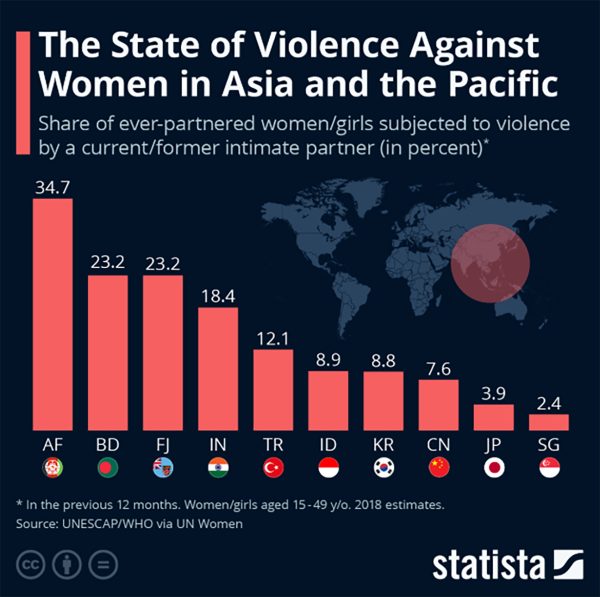
These three countries alone are among the four highest percentages in Asia, and they share one thing in common. They belong to South Asia. They belong to us.
Research conducted in the United States by Shreya Bhandari and Bushra Sabri reveals patterns that mirror what many of us have seen but struggled to name: women isolated from friends and relatives, financially restricted, constantly monitored, and repeatedly forgiven only for violence to escalate again.
As reported by Bhandari and Sabri, one survivor explained that control was exerted so thoroughly that she became “completely dependent on the abusive partner with no support from anywhere.” This is not about anger. This is about power.
Honor-based violence does not begin with bruises. It starts with surveillance, suspicion, financial dependency, and shame. It is perpetuated through silence, through immigration vulnerability, through the belief that preserving family reputation is more important than protecting a woman’s life.
Some will argue that progress is being made, and they are not wrong. Organizations like the Newham Asian Women’s Project in London have demonstrated that activism can empower survivors through advocacy, legal support, education, and mental health interventions.
As Aisha Gill, and Gulshun Rehman write, “Excluded and marginalised communities have organised at the local and grassroots levels to lead and direct community-development initiatives designed to improve their social, political, and economic status.” However, acknowledging progress should not become an excuse for satisfaction.
The same scholars remind us that violence against women exists in all societies and that its psychological toll is long-lasting and deeply rooted. For every woman who finds help, there are countless others still trapped by family pressure and the unbearable weight of dishonoring their parents.
I ask you one thing. As parents, nanis, aunties, and dadas, confront the truth that silence is not neutrality. Silence is permission.
You have the authority to shape the norms of our community. You have banned spaghetti straps at family gatherings and dictated who our future generations should marry. You therefore also have the authority to say that violence disguised as preserving honor will no longer be tolerated.
Teach your sons that control is not a sign of masculinity, but rather a sign of weakness. Teach your daughters that obedience is not safe, but dangerous. Create community spaces where asking for help is not an act of betrayal, but an act of courage.
We are proud people who work hard to achieve the best lives for ourselves. Let us be proud of protecting our daughters, instead of patrolling them. Let us become known for how we end our pain, instead of hiding it.
Sincerely,
Amay Cholia