

Swimming has been a competitive sport since the early 1800s. The first swimming competitions started in London in 1837. The only stroke used in the competitions was breaststroke. Beginning in 1896, swimming became part of the contemporary Olympics. This change helped swimming become popular worldwide. At first, only men were able to compete, but later, in 1912, women were included. Since then, new strokes were adopted, equipment was improved, and swimmers shattered records.
Today, swimming ranks as one of the top four favorite and crowd-pleasing Olympic sports, right up there with gymnastics, track, and basketball.
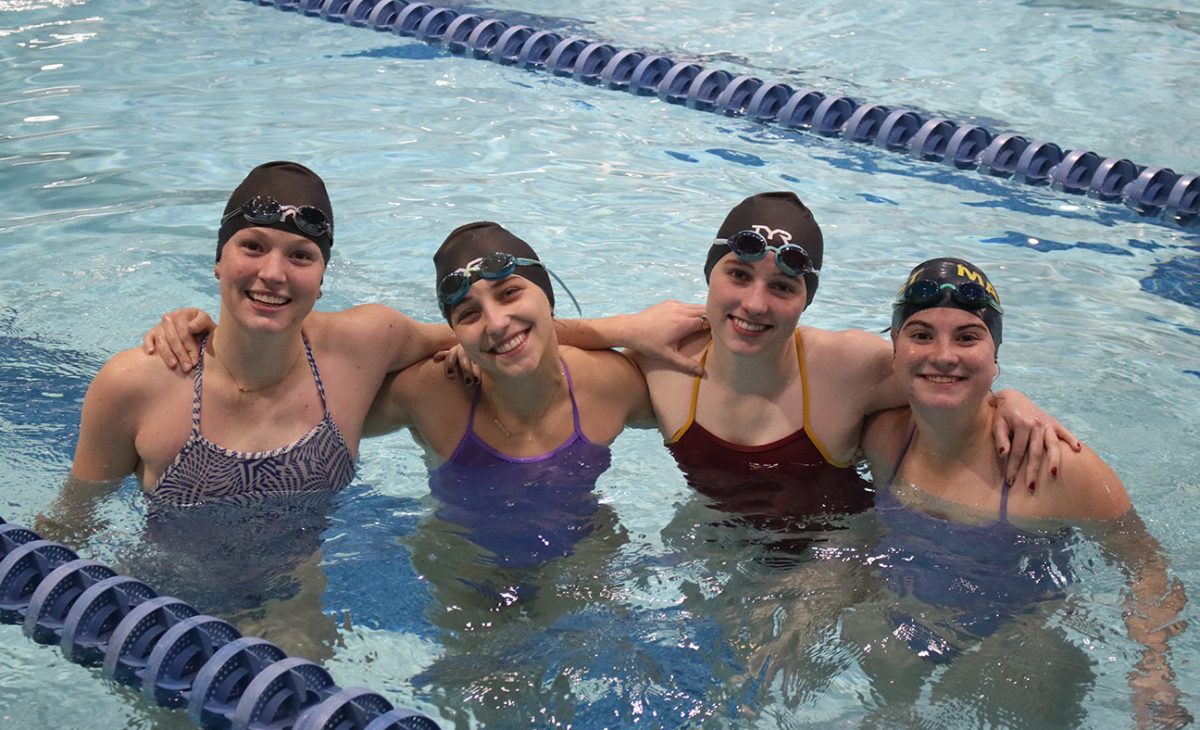
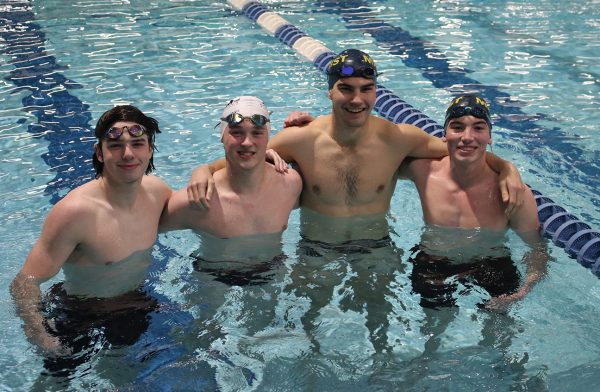
Swimming is one of the few sports that focuses on individual competition while building friendships on a team. The Marist swim teams have won multiple state championships. In recent years, the girls have been state champions in both 2022 and 2025.
The boys have been champions in 2020, 2021, and 2022. In fact, our boys swim team is ranked eighth, and the girls’ team is ranked second in the state of Georgia! Right now, the boys’ record is 3-2, while the girls’ is 4-1. These winning teams deserve lots of school support.
The swim season starts in the fall or winter with practices every Monday through Saturday from 4 to 6:30 pm. People might be surprised to learn that swim teams usually start their practices either on the football field or in the weight room. For example, swim teams often do stretching and cardio and work on their core. In the weight room, they build up their strength for their strokes and starts.
For our team at Marist, freshman swim team member Lucy Thomas explains how swimming has helped connect her to other students. “My experience on the Marist JV and Varsity team has been an amazing way to connect with older peers. The Marist swim team has also allowed me to become closer to others as we grow and train on the team,” she said.
A swimmer since seventh grade, Thomas noticed the differences between the middle school and JV teams. “One difference between the middle school team and the Marist JV and Varsity team is longer practice lengths, later practices, and dryland at the start of practice,” she said.
The swimmers’ practices typically consist of three parts: a warm-up, a main set, and a cool-down. Senior swim captain Andrew Wiegand explains what the swimmers do. “For the swimming portion, there is usually a 15-minute warmup, then some easier full workout sets that could involve using equipment and possibly a pull or kick set, followed by at least one main set, where we get most of the distance and hard work for the practice in. Then, we will always end with a cool down,” he said.
Diving is also a very important part of the swim team and does not get nearly as much attention and recognition as it deserves.
Merritt Grassi, a senior on the dive team, explains how important the team really is. “On announcements, it will often say an upcoming swim meet or the swim team, and the dive team will not be mentioned. This can be hard at times as we each play a contributing role in the overall score of the team, and in some instances have been the reason for winning local or state meets,” she said.
Diving practices are usually very different from the regular swim team practices.
Grassi explained what they regularly do for their practices. “Diving practices are normally around two hours Monday – Friday. If we have a meet the next day, then that practice, we will normally do between two and four of each of the six dives we will compete at the meet the next day. If we don’t have a meet the next day, then we will usually work on two or three of the dive groups out of the five,” she said.
Grassi also explained that the divers warm up before practice differently from the swimmers. “Before each practice, we will stretch for about 15 minutes and then warm up on the board with front jumps and front rainbow dives,” she said.
Just like swimming, the divers have different dives they can select for competitions.
Grassi listed all the different kinds of dives they are able to do at Marist. “There are five groups of dives: fronts, backs, inwards, reverses, and twisters. For Marist, on a one-meter diving board the average list consists of one and a half tuck or pike, double tuck, back one and a half tuck or pike, inward one and a half tuck, reverse dive tuck or pike, or reverse one and a half tuck, and front full twist, front one and a half full twist, back one and a half full twist, or back one and a half,” she said.
Just like the swim team, the divers were amazingly successful this year. The girls’ record so far is 5-0 while the boys’ is 4-1. In recent years, both the girls and the boys diving teams won the Metro Championships in 2025. In 2021, the boys earned a region title.
Grassi goes on and explains how much she enjoys being on the dive team. “I have loved being a diver during my time at Marist. The team is very close, and we have fun at all the practices,” she said.
On February 3, the team will compete at the GHSA 4A State Championship at Georgia Tech for another state title and end their season.